

Gum Treatment
The most common gum diseases are gingivitis and periodontitis.
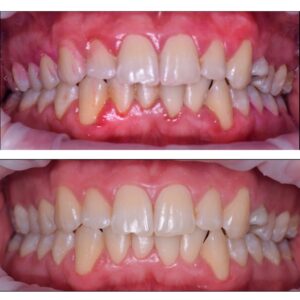
Gingivitis – is the early stage of gum disease. It causes gum inflammation and bleeding.
Treatment begins with professional dental cleaning, performed by a dentist under a microscope to ensure maximum precision.
Signs of Healthy Gums
Healthy gums are light pink in color and fit tightly around the teeth.
They protect tooth roots and jawbone from harmful bacteria.
Symptoms of Unhealthy Gums
- Inflamed, sensitive gums
- Bleeding during brushing
- Increased tooth mobility
- Teeth appearing longer due to gum recession
- Receding gums forming periodontal pockets
(periodontal pockets result from inflammation caused by infected plaque) - Bad breath
The main cause of gum disease is dental plaque. If plaque is not removed daily, it hardens and allows bacteria to damage not only the gums and teeth but also the supporting bone.
As a result, teeth may loosen and eventually fall out.
That’s why we strongly recommend brushing twice a day and visiting the dentist every six months for professional cleaning.

Periodontitis Treatment
1. Diagnosis
The dentist evaluates periodontal tissues by:
taking X-rays
completing a periodontal chart using a periodontal probe to measure pocket depth and location
2. First Stage of Treatment
Professional dental cleaning under a microscope with removal of supragingival plaque.
Ultrasonic scaling removes plaque and tartar, significantly reducing inflammation.
Interdental areas are polished with AirFlow using glycine powder, which is gentle and does not damage enamel.
If necessary, interdental strips are used for additional polishing.
3. Second Stage
Subgingival scaling — removal of bacterial deposits and calculus from root surfaces and periodontal pockets.
4. Surgical Treatment
For periodontal pockets deeper than 6 mm, surgical treatment (curettage) is performed.
After Treatment
It is essential to follow all doctor’s recommendations, as there is a high risk of recurrence, even if the patient:
is clinically healthy after successful treatment;
has mild bleeding in shallow pockets (<3 mm);
has closed pockets up to 4 mm without bleeding.
Q&A
Bleeding during tooth brushing is not normal. It is a sign of inflammation caused by the buildup of dental plaque and tartar under the gums.
If you notice bleeding gums, we recommend scheduling professional dental cleaning under a microscope.
TO BOOK AN APPOINTMENT, CALL
+38 066 358 88 64